Article · November 2, 2026
No ChatGPT App? You may lose more than traffic
ChatGPT apps can be an exercise in agentic readiness: reusable service architecture, safe actions, evaluation and measurement beyond referral traffic.
In this article
That sounds intentionally provocative. But the interesting part is not really the traffic.
It is the emergence of a completely new distribution and execution layer.
The platform examples discussed here are:
- OpenAI: plugins, connected apps, skills and MCP-powered integrations.
- Google: the Connected Apps Platform for Gemini and Search.
- Anthropic: MCP connectors and integrations inside Claude.
These are platform developments described in the original article, rather than a verified inventory of currently available features. In particular, legacy ChatGPT plugins and current apps should not be treated as the same product. Availability and supported actions need to be checked against each platform’s current documentation before implementation. The strategic implications below are my analysis.
Three different ecosystems. One very similar direction
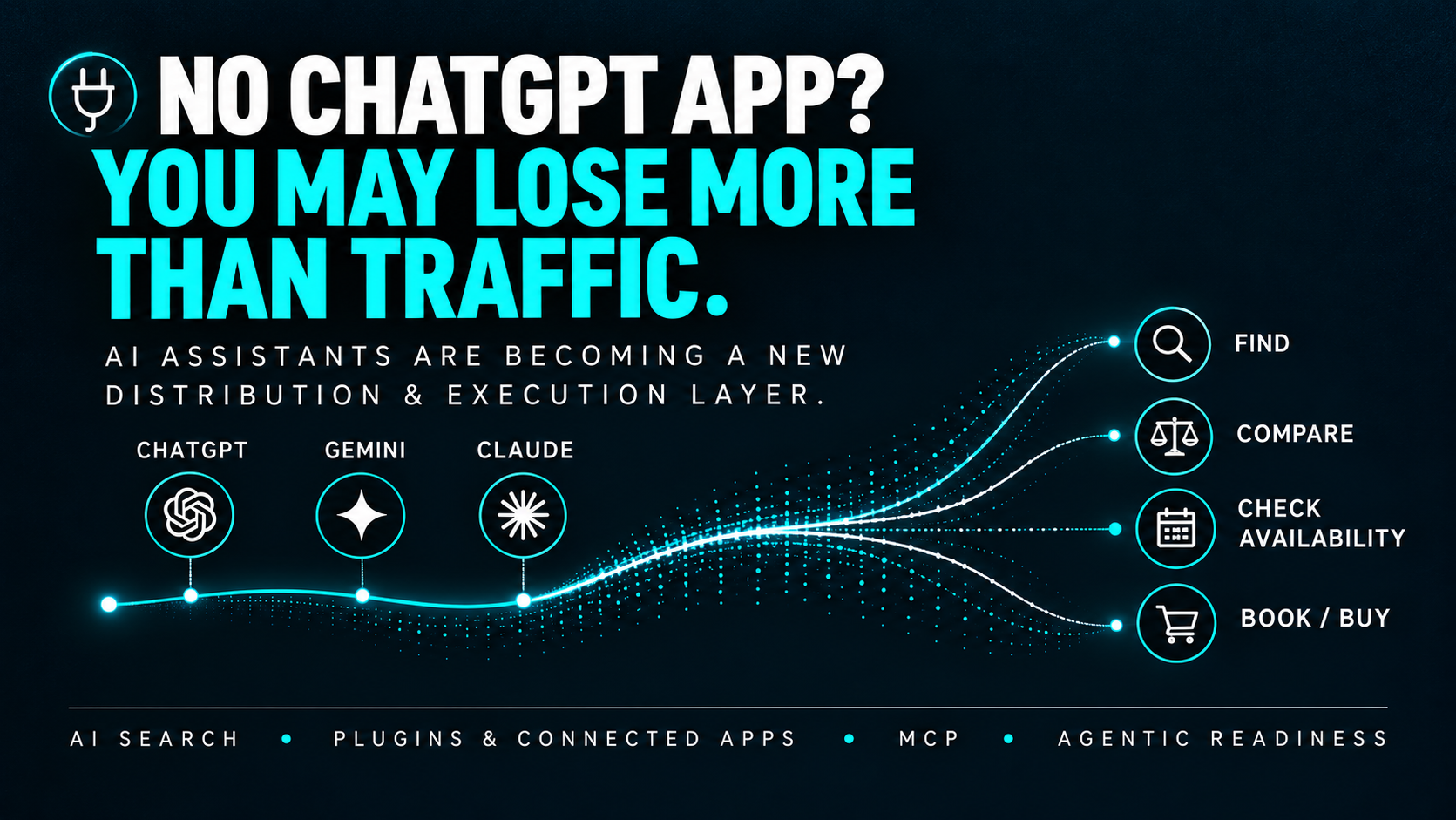
AI assistants are moving beyond simply answering questions.
🤖 The journey is becoming:
Question → Intent → External service → Live information → Decision → Action
And that changes the strategic question.
It is no longer only:
“Can an AI system find, understand and cite my website?”
It increasingly becomes:
“Can an AI system actually use my service?”
That distinction matters.
From information retrieval to action
Imagine travel.
A user may not want another article comparing hotels.
They may simply want to say:
“Find me a hotel near the conference, compare the options, check availability and book the best one.”
The journey becomes:
🔎 Find → ⚖️ Compare → 📅 Check availability → ✅ Book
Or e-commerce:
🛒 Find product → Check size / stock → Compare → Purchase
Or a marketplace:
📍 Find providers → Compare availability → Select → Book
The website still matters.
SEO still matters.
Content still matters.
But the website may no longer be the only interface between the customer and the business.
An AI assistant can increasingly become another interface to the service itself.
And that is why I would look beyond the question of whether an integration generates referral traffic.
A ChatGPT integration is also an Agentic Readiness exercise
I would not treat a ChatGPT app or integration as simply another branded application.
I would treat it as an opportunity to build Agentic Distribution Readiness.
Because the most valuable work happens underneath the interface.
A company needs to understand:
- Which real user jobs should an agent be able to complete?
- Which APIs or dedicated endpoints should be exposed?
- Are inputs and outputs structured clearly enough for an AI system?
- How should authentication and delegated access work?
- Are permissions sufficiently granular?
- Is latency predictable enough for conversational interaction?
- Can requests be retried safely?
- Can duplicate orders, bookings or requests be prevented?
- Can the system recover from stale state or interrupted sessions?
- Which actions require explicit human confirmation?
- Can failures be explained clearly to the agent and ultimately to the user?
- Can we monitor tool usage, errors, latency and completed actions?
- Can we evaluate when the AI should — and should not — invoke our service?
This is much more than creating another chatbot.
It requires thinking about your product as something that can be understood and operated by software acting on behalf of a user.
Build once? No. Learn once? Absolutely
This is where the direction of the major AI ecosystems becomes particularly interesting.
MCP is part of the connective infrastructure discussed here between AI systems and external services. The platform claims in the original article are:
- Anthropic introduced MCP, described in its announcement, “Introducing the Model Context Protocol”.
- OpenAI supports MCP-based integrations, as described in its Apps SDK documentation.
- Google’s Connected Apps Platform supports remote MCP servers, according to the original article.
The current scope of these platform claims has not been independently verified for this edition. Treat them as reported context, particularly the Google platform claim, rather than confirmation of deployment eligibility or feature parity.
This does not mean that a company can build one integration today and deploy exactly the same implementation everywhere tomorrow.
Each ecosystem can still have different requirements around:
- authentication
- permissions
- UI
- review processes
- platform policies
- host-specific functionality
- security
But the underlying experience is reusable.
If your team has already learned how to expose a service correctly to ChatGPT, you have already learned a lot about:
- ⚙️ tool architecture
- 🔐 authentication
- 📡 APIs and endpoints
- 🧩 structured schemas
- ⏱️ latency
- 🔄 retries and state
- 🛡️ permissions and safety
- 📊 observability
- 🧪 evaluation
- 🤖 agent behaviour
And that changes your starting position when another platform becomes strategically important.
You are not starting from zero.
A future Gemini, Claude or another agent integration may still require work.
But your organization has already developed part of the technical and operational muscle required to build it.
That can shorten the path from:
“We should probably explore this.”
to:
“We know what needs to be built.”
A new optimization layer is emerging
There is another aspect of this trend that I find particularly interesting from an SEO / GEO perspective.
In traditional SEO we spend a lot of time helping search engines understand:
- pages
- entities
- relationships
- relevance
- products
- availability
- content
Agentic environments introduce another problem.
We also need to help an AI system understand:
- what a tool does
- when it should use it
- what inputs it requires
- what it can safely change
- what permissions it needs
- what output it returns
- when another tool would be more appropriate
- when it should not call the tool at all
Tool names, descriptions, schemas and behavioural metadata therefore become important.
But I would be careful with the terminology.
This is not simply another SEO ranking factor.
It is an optimization problem around whether an AI system can correctly understand, select and invoke a capability.
That is a different discipline.
And potentially an important part of future GEO and Agentic Readiness.
Traffic alone will not measure this properly
This is also why measuring these integrations only through AI referral traffic would be incomplete.
I would want to understand several layers.
Agent usage
- tool invocations
- connected users
- repeat users
Technical quality
- latency
- failed actions
- authentication failures
- retries
- incomplete tasks
Task completion
- successful searches
- completed bookings
- completed purchases
- submitted leads
- requested quotes
Business impact
- conversion
- orders
- bookings
- revenue
- repeat usage
- customer value
Journey problems
- abandonment points
- tools frequently called incorrectly
- actions users fail to complete
- endpoints creating excessive latency
Because some of the value may happen without a traditional website visit at all.
That creates an important measurement distinction:
AI visibility ≠ AI referral traffic ≠ agent usage ≠ transaction ≠ incremental business value
These stages should not be mixed together.
Does every company need a ChatGPT app?
No.
That would be exactly the kind of simplistic recommendation I would avoid.
A company may gain very little if it has:
- no useful live data
- no meaningful user actions
- no transactional capability
- no service worth exposing to an agent
But the situation becomes very different when users can:
- 🔎 search inventory
- 📦 check availability
- ⚖️ compare products or services
- 👤 manage an account
- 💬 request a quote
- 📅 make a reservation
- 🛒 purchase something
- 🔄 change or manage an existing service
For businesses like these, I would start thinking about Agentic Readiness now.
- Not because ChatGPT will necessarily become the dominant interface for every customer.
- Not because having an app guarantees traffic.
- And certainly not because an integration automatically creates revenue.
But because the direction of travel across the largest AI platforms is becoming difficult to ignore.
The real strategic question
I do not think the most important question is:
“Do we need a ChatGPT app?”
The better question is:
If ChatGPT, Gemini, Claude or another agent wanted to use our service tomorrow, how ready would we be?
Could we expose the necessary capability in weeks?
Or would we first need to redesign:
- APIs
- authentication
- permissions
- endpoints
- state management
- business logic
- monitoring
- evaluation
That difference may become increasingly important.
A ChatGPT implementation can be the first use case.
But the real asset is the architecture, knowledge and operational experience behind it.
And that is why I see these integrations not only as another potential source of traffic.
I see them as another layer of Agentic Readiness.
Sources and verification scope
- Adam Miszczak, “No ChatGPT App? You may lose more than traffic”, 2 November 2026: original article and strategic analysis.
- Anthropic, “Introducing the Model Context Protocol”: primary announcement identified for the MCP origin claim.
- OpenAI, Apps SDK documentation: primary documentation identified for MCP-based ChatGPT app integrations.
- Google, Connected Apps Platform for Gemini and Search: platform description reported in the original article; remote MCP support and current availability remain unverified in this edition.
The platform references above identify the organizations and materials behind the technical context; they were not independently rechecked for this edition. The travel, e-commerce and marketplace journeys are illustrative scenarios, not measured case studies or guarantees of supported actions. An integration’s commercial value remains a hypothesis to test: usage, referrals or transactions alone do not establish incremental revenue or causation.
Your perspective matters
What are you seeing in practice?
Which of these changes is already affecting your team? Share your experience on LinkedIn or read the related note on Substack.