Article · October 14, 2026
OpenAI and ChatGPT Product Feeds Are Becoming SEO/GEO Infrastructure
Why ChatGPT product feeds matter for enterprise e-commerce discovery, data freshness and measurement beyond advertising.
OpenAI and ChatGPT product feeds are not just for ads. They are another reason to treat product data as part of an enterprise e-commerce search and discovery system.
OpenAI has announced product discovery integrations involving retailers including Target, Sephora, Nordstrom, Lowe’s, Best Buy, The Home Depot and Wayfair. Product results in ChatGPT are selected independently and are not ads. Approved merchants can also provide structured product feeds, while advertising has separate eligibility and campaign controls.[2] [3] [6]
Feed eligibility is not a visibility guarantee
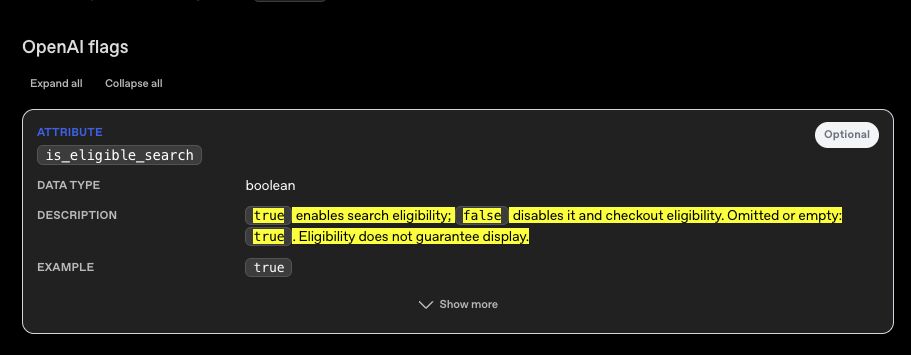
In OpenAI’s product specification, is_eligible_search: true makes an item eligible for search discovery. It does not guarantee that the product will appear for a particular query or user.[1]
That distinction matters for planning and reporting. A feed gives a provider structured product information and can make products eligible for a surface. It is not a promise of impressions, placement, traffic or sales.
Fresh catalog data supports better product discovery
OpenAI recommends an up-to-date catalog, including regular full snapshots and updates when product information changes. Its onboarding guidance describes daily full-feed refreshes and more frequent updates through the API.[4]
Keeping price, availability and product details current can reduce errors caused by stale or inconsistent catalog data. I would not describe this as “hallucination prevention”: a feed cannot guarantee that an AI system will always return correct answers. Nor does a current feed eliminate redirects or 404s. Product URLs still need to resolve correctly, and feed freshness depends on the quality of the source data and update pipeline.
Make feed performance measurable
OpenAI recommends feed attribution parameters for tracking clicks from product feeds.[5] For an enterprise e-commerce team, that creates a starting point for measuring feed traffic by landing page, product group and market, then connecting it to downstream conversion data.
Keep attribution conventions stable across feed updates and validate the destination URLs. Without consistent tagging and analytics, product-feed discovery can be difficult to distinguish from other referral traffic.
Build a shared product-data capability
Product feed optimization is becoming multi-provider SEO/GEO infrastructure. For international marketplaces with hundreds of millions of product URLs, a governed product-data layer can be more scalable than treating each discovery integration as an isolated project.
That does not mean every provider accepts the same feed format. The practical architecture is a reliable shared source of product truth, with provider-specific adapters, eligibility rules, update schedules and measurement. Teams that already maintain clean, fresh and measurable catalog data will have a stronger starting point as more discovery providers expose feed interfaces.
Sources
Your perspective matters
What are you seeing in practice?
Which of these changes is already affecting your team? Share your experience on LinkedIn or read the related note on Substack.