Article · October 22, 2026
SEO and GEO Should Work as a System
Connect search, AI discovery and marketing channels around the customer journey, reliable information and measurable business value.
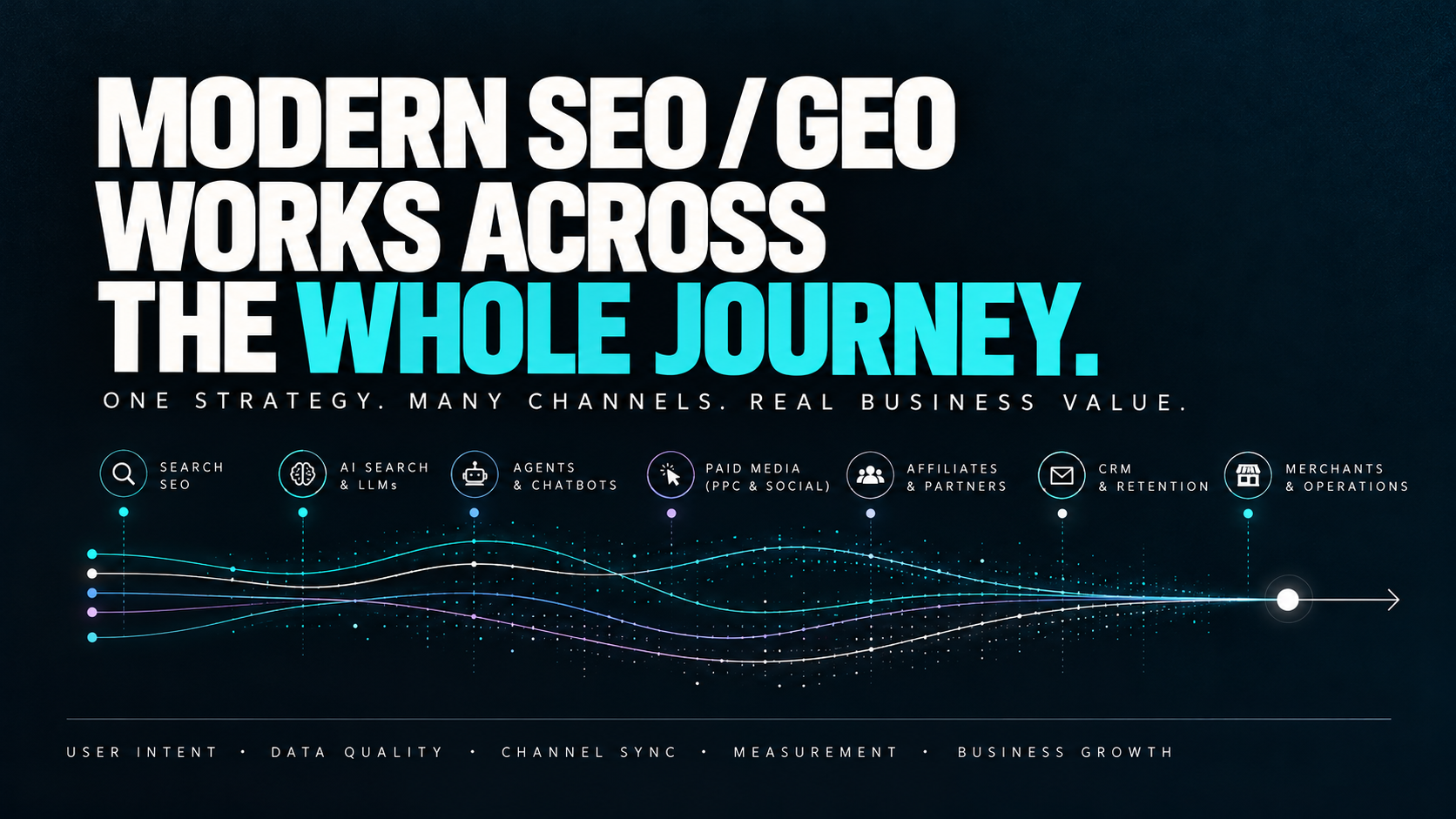
Connecting search, AI discovery and marketing channels around the customer journey and measurable business value.
A useful SEO/GEO strategy should answer more than:
“How do we get more visibility?”
The bigger question is: How do we help the right customer discover, understand and choose the right offer - and make that journey valuable for the business?
My view is that SEO and GEO should connect with paid media, CRM, affiliates, Product and Commercial teams through shared customer needs and reliable information.
Not by making every team do the same thing, but by making their work support the same journey.
Start with the customer’s task
Imagine someone looking for:
“A cordless vacuum under €300, suitable for pet hair, delivered by Friday.”
They might start with traditional search, compare recommendations in an AI answer, follow an affiliate review, and ask an on-site chatbot about an attachment.
This is an example, not a fixed customer journey. What matters is what must stay correct throughout it.
Does the product meet the requirement? Is the price for the selected variant? Is the attachment included? Can it arrive on time?
The customer should not have to reconstruct the truth after every click.
That changes how I would prioritise work. Before building another page, I would check whether we have suitable inventory, whether an existing destination serves the need, and where the journey actually breaks.
Sometimes the answer is better discovery. Sometimes it is clearer product information. Sometimes it is a supply problem that content cannot solve.
Give each channel a role in the shared plan
Cross-channel cooperation should produce better decisions, not just another meeting.
- Paid search: Use query and conversion evidence to identify valuable needs and weak destinations. Test combined paid-and-organic results rather than competing for credit.
- Paid social, creators and Brand: Use tested messages and authentic demonstrations to improve comparisons and landing pages. Preserve the promise made before the click.
- CRM and lifecycle marketing: Use repeat behaviour and customer questions to inform acquisition priorities and useful follow-up journeys.
- Affiliates and partners: Provide reliable destinations and current offer information. Evaluate customer quality and additional demand after partner costs.
- Product, Engineering and Commercial: Connect search demand with inventory, purchase friction and customer complaints. Fix the constraint rather than automatically producing more content.
The shared asset is an understanding of the customer need - not identical copy distributed everywhere.
Internal searches, paid queries and recurring conversational requests can feed one opportunity backlog. Each need should map to an existing page, a justified new destination, or a supply opportunity.
Scale useful page families and reusable components - not every keyword variation.
Discovery also needs implementation. Google says Googlebot generally does not submit queries into website search boxes, so useful listings should not depend on internal search alone to be found.
Build one reliable set of facts
A product or service can appear on a page, in structured data, through a feed, inside a chatbot and during checkout.
I would connect those representations to clearly owned information: stable identifiers, authoritative sources, refresh rules and someone responsible for inconsistencies.
For products, that includes the exact variant, seller, price, availability and delivery conditions. For services, it may include the branch, duration, group size and booking requirements.
Google Merchant Center documents problems caused by mismatches between submitted product information and landing pages.
Different channels can use different formats and legitimate promotions. The conditions simply need to remain clear.
The presentation can change. The underlying facts should not become contradictory.
This broader approach does not replace technical SEO. For Google’s AI Overviews and AI Mode, established SEO practices remain relevant, and there is no special AI schema required.
Nor should every AI system be treated the same. OpenAI documents separate controls for search and training crawlers, for example.
Prepare for decisions and actions - not just mentions
I would separate three levels of readiness:
- Discovery: Can the system find the right product, service or page?
- Decision: Can the customer or assistant compare options accurately and understand the restrictions?
- Action: Can an authorised purchase or booking be completed reliably?
A readable catalogue does not prove that an agent can select the correct variant, validate the current total, or recover safely from a failed transaction.
OpenAI’s documentation makes a related distinction: product discovery data and checkout require separate capabilities. Its checkout specification includes transaction states, validation and error handling.
For an on-site chatbot, I would require the same verified facts as the product page. It should ask for missing information rather than invent a delivery promise or confuse an available voucher with a confirmed appointment.
A useful answer supports the correct next step. A confident answer is not enough.
Measure the outcome, not only the exposure
Rankings, clicks, citations and channel conversions remain useful diagnostics. I would not let any one of them define success.
My scorecard would connect relevant discovery with information accuracy, completed purchases, contribution after relevant costs and customer value.
Repeat purchasing matters where it fits the category. A durable product should not face the same short-term retention expectations as a frequently purchased service.
I would also keep attribution separate from incrementality. Attribution assigns credit under a measurement model. Incrementality asks what happened because of the activity. Google’s Conversion Lift documentation distinguishes these concepts.
For AI, I would keep mentions, citations, referrals and integration transactions separate. I would also test complete tasks: follow-up questions, correct variants and working handoffs - not just isolated answers. That is the approach I discussed in my article on AI prompt monitoring.
A better channel report is not automatically proof of a better business result.
Make the strategy operational
Every funded opportunity should have a customer need, an owner, a delivery commitment, acceptance criteria and a measurement plan.
Weekly reviews should focus on what shipped, what failed and which decision is blocking progress. Monthly reviews should decide what to expand, revise or stop.
AI can support research, production and validation. I would measure its value through delivery time, review effort, rework and errors - not content volume.
For me, SEO/GEO leadership does not mean owning every channel. It means making search expertise useful across teams and helping turn it into shipped improvements.
Better discovery. Consistent information. Reliable actions. Measurable business value.
That is the system I would build.
References
- Google: AI features and your website
- Google: Ecommerce website structure
- Google Merchant Center: Price and availability inconsistencies
- OpenAI: Crawler documentation
- OpenAI: Product-feed specification
- OpenAI: Agentic Checkout specification
- Google Ads: Conversion Lift measurement
- Adam Miszczak: AI Prompt Monitoring Is Broken, Because the Prompt Isn’t the User
Your perspective matters
What are you seeing in practice?
Which of these changes is already affecting your team? Share your experience on LinkedIn or read the related note on Substack.